

The Super Bowl LIX halftime show underwent a historic transformation on Sunday as Bad Bunny turned the Levi’s Stadium in Santa Clara into a vibrant celebration of Puerto Rican soul. Breaking long-standing industry norms, the 31-year-old superstar—crowned Spotify’s top global artist of 2025—delivered the first-ever halftime performance conducted entirely in Spanish.
Rather than leaning into the expected political firebrand persona, the artist born Benito Antonio Martínez Ocasio utilized a 14-minute medley to bridge cultural divides while keeping his Caribbean roots front and center.
A Cinematic Tribute to “La Casita”
The stage design traded traditional stadium glitz for “la casita,” the iconic Puerto Rican house that has become a staple of Bad Bunny’s live aesthetics. This immersive Latin American universe featured everything from nail salons to local bars, creating a backdrop for a high-energy setlist including hits like “Tití Me Preguntó,” “MONACO,” and “BAILE INoLVIDABLE.”
The performance felt like a family gathering of titans. Lady Gaga joined the fray with a salsa-infused rendition of “Die With A Smile,” while Ricky Martin reinforced the island’s pride with “Lo Que Le Pasó A Hawaii.” High-profile cameos from Pedro Pascal, Cardi B, Karol G, and Jessica Alba—herself of Puerto Rican descent—dancing on the casita’s porch emphasized a message of communal joy.
Language as an Act of Resistance
The absence of English lyrics or subtitles sparked immediate social media debates, highlighting what sociologist Clara Rodríguez describes as a “deep-seated American discomfort with multilingualism.” Bad Bunny addressed this directly during his press conference, noting that while English isn’t his mother tongue, “it isn’t the mother tongue of America either.”
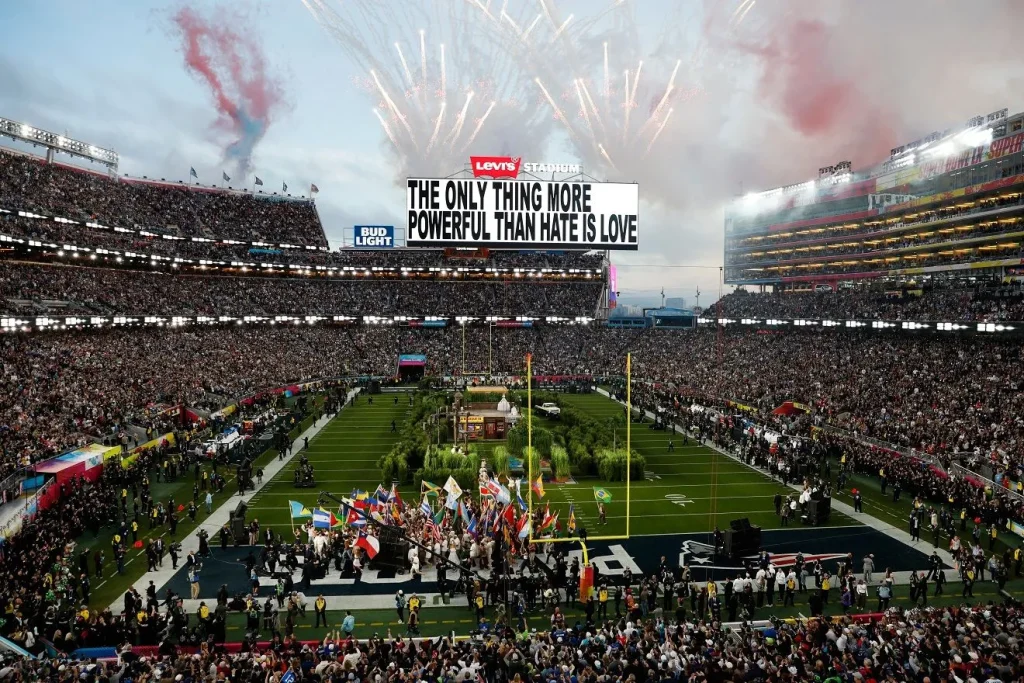
By refusing to translate his art, he successfully dominated the mainstream on his own terms. However, he did weave two specific English messages into the finale’s choreography:
-
A glowing sign behind him declared, “The only thing more powerful than hate is love.”
-
Before his exit, he slammed a football into the turf engraved with the words: “Together, We Are America.”

Subtle Symbolism and Political Undercurrents
While the singer avoided a direct verbal attack on the administration, his visual cues spoke volumes. During a particularly poignant segment, he performed atop an electrical pylon—a stark reminder of Puerto Rico’s shattered infrastructure following Hurricane Maria in 2017.
His attire also carried weight; he wore a beige sweater emblazoned with the number 64, honoring the official death toll of the hurricane that was famously disputed by island residents who felt abandoned by federal relief efforts at the time.
Backlash and “Unacceptable” Reviews
The performance did not sit well with everyone. Donald Trump took to Truth Social to label the show “totally unacceptable” and an “insult to the country.” The former president criticized the lack of English, described the choreography as inappropriate for children, and dismissed the show as one of the worst in NFL history. He further attacked the media for what he perceived as overly positive coverage.
Despite the criticism, Bad Bunny’s closing moments solidified his intent. After shouting “God bless America,” he listed nations across Latin America, the U.S., and Canada, reclaiming “America” as an entire continent rather than a single country. His final words, “Seguimos aquí” (We are still here), served as a defiant reminder of Puerto Rican resilience.
Así fue el show de medio tiempo de Bad Bunny en el #SuperBowl https://t.co/PBlYbUbT6M
— Real Time (@RealTimeRating) February 9, 2026