
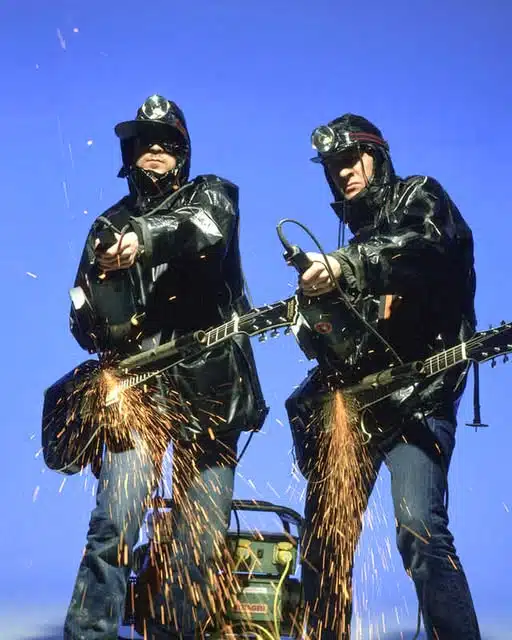

KLF: The Most Dangerous Experiment in Pop Music History
Some bands leave a mark. Others leave ruins. The KLF belong firmly in the second category — and that’s precisely what makes them unrepeatable. They weren’t simply one of Britain’s greatest electronic acts. They were a living experiment in the meaning of success, money, art and self-destruction — one that ended with a million pounds sterling turning to ash in an abandoned boathouse on a remote Scottish island in the middle of the night.
In 1991, the KLF were the number-one singles act in the entire world. A year later, they no longer existed. They had announced their immediate retirement, deleted their entire back catalogue from sale, and walked away — leaving behind a stunned music industry that didn’t know whether to laugh, worry, or simply stand in awe. This is their story.
“We have been following a wild and wounded, glum and glorious, shit but shining path these past five years… If we meet further along, be prepared.”
— KLF, Retirement Statement, 14 May 1992
KLF History: From Sample Chaos to the Sound of the Future
The story begins in 1987 in London, with two men who had absolutely nothing to lose. Bill Drummond — a Scottish musician who had worked as manager for Echo & the Bunnymen — and Jimmy Cauty — an English guitarist from the band Brilliant — formed a partnership that resembled a philosophical brotherhood far more than a pop group. They named themselves The Justified Ancients of Mu Mu, a title borrowed directly from Robert Anton Wilson’s Illuminatus! Trilogy novels: a satirical epic about shadow organisations, paranoia and the true meaning of anarchy.
It was no random choice. Drummond and Cauty fully embraced the philosophy of Discordianism — the idea that chaos is the only truth and every apparent “order” is a collective delusion. This became the core of every move they made, from the music itself to the most audacious performance art.
Their debut as the JAMs, the album 1987 (What the Fuck Is Going On?), was an audio scandal: unchecked samples from ABBA, the Monkees, Samantha Fox, the Beatles — no clearances, no apologies. When ABBA responded legally and demanded the record’s withdrawal, Drummond and Cauty turned it into a performance: they publicly burned remaining copies in a Swedish field and released a replacement, 1987: The JAMs 45 Edits — the same LP, with every sample replaced by silence. The irony, of course, was the point.
🔑 KLF Aliases & Alter Egos
- The Justified Ancients of Mu Mu (JAMs) — 1987, hip-hop / sample-heavy era
- The Timelords — 1988, UK #1 with “Doctorin’ the Tardis”
- The KLF — 1988–1992, stadium house & ambient house dominance
- K Foundation — 1992–1995, art collective & the million-pound burning
- 2K — 1997, brief comeback with “Fuck the Millennium”
- Justified Ancients of Mu Mu (return) — 2017, book 2023: A Trilogy
“Doctorin’ the Tardis”: A Blueprint for Anarchy
In 1988, under the alias The Timelords, Drummond and Cauty released “Doctorin’ the Tardis” — a chaotic mashup of the Doctor Who theme, Gary Glitter’s “Rock and Roll Part 2” and the Sweet’s “da da da.” It hit number one on the UK Singles Chart within weeks.
That alone would be remarkable enough. What followed was extraordinary: they wrote a book, The Manual (How to Have a Number One the Easy Way), explaining step by step how they had manufactured a chart-topper without knowing how to play instruments. Their argument? The charts are so predictable that anyone can game the system if they understand the mechanics. The book sold well. The KLF moved on, entirely unbothered.
Stadium House: When Rave Became a Global Phenomenon
The transition to The KLF (Kopyright Liberation Front) marked a radical shift in direction. Drummond said it plainly in 1988: “We want to make pure dance music, free of rap.” They launched the “Pure Trance” singles series — minimalist, acid house tracks that circulated quietly across continental Europe and found an audience in underground clubs.
The explosion came in 1990 with the Stadium House Trilogy: What Time Is Love? (Live at Trancentral), 3 A.M. Eternal and Last Train to Trancentral. These three landmark singles weren’t simply great records. They were a new language: rave energy married to pop-rock production, fake crowd noise that made every listen feel like a world event. Drummond coined the term “stadium house” and wasn’t wrong — within months they were filling Europe’s biggest rave venues, blasting polystyrene pellets and Scottish banknotes at the crowd.
“It throbs and pulses in a still-riveting manner that transcends the dated beatdrops. The kind of song that sends electrifying impulses through the drum kit and straight into your bloodstream.”
— Splendid Magazine, on “What Time Is Love?”
Chill Out (1990): The Album That Invented a Genre
Running parallel to their stadium house conquest, the KLF released what may be their most enduring legacy: Chill Out (1990). Forty-five minutes of uninterrupted ambient music — no track titles, no breaks, a continuous imaginary road trip from Texas to New Orleans. Samples from Fleetwood Mac, Elvis, Acker Bilk and others surfaced and dissolved like radio frequencies caught drifting across the dial.
Chill Out is today recognised as one of the founding texts of the ambient house genre. AllMusic called it “one of the essential ambient albums.” Mixmag ranked it among the five greatest dance albums of all time. Jimmy Cauty had meanwhile co-founded The Orb — and the road to 1990s ambient techno lay wide open.
The White Room (1991): The Summit Before the Fall
1991 was their golden year. The album The White Room reached number three in the UK. Singles followed each other into the charts in rapid succession. Then, in December 1991, came “Justified & Ancient (Stand by the JAMs)” — a collaboration with Tammy Wynette, “The First Lady of Country Music.” Drummond flew personally to Nashville to produce the recording of her vocals. The result went to number one in 18 countries, number two in the UK, and number 11 on the Billboard Hot 100.
Nobody could quite explain why a rave duo was collaborating with a country legend from the 1960s. That, of course, was entirely the point.
BRIT Awards 1992: The Most Scandalous Night in British Music
February 1992. The BRIT Awards honour them as the year’s defining act. Rather than accepting gracefully, they took the stage alongside crust punk and grindcore heavyweights Extreme Noise Terror and performed a brutal, ferocious version of “3 A.M. Eternal” while firing blank machine-gun rounds at the audience. The room fell into stunned silence.
At the aftershow party, they left a dead sheep at the entrance with a note reading: “I died for ewe — bon appétit.” The American television producer of the evening asked what it meant. He received no answer.
Three months later, they announced their retirement and deleted their entire catalogue from sale. The statement was written in the register of a farewell poem.
The K Foundation and the Burning of One Million Pounds
Rather than resting, Drummond and Cauty transformed themselves into an art collective: the K Foundation. And here their story takes on the dimensions of legend.
First came the “K Foundation Art Award” — an alternative prize for the worst artist of the year, paying out double the Turner Prize money. The winner was Rachel Whiteread — the same artist who won the Turner Prize that year. When Whiteread initially refused the award, collaborator Gimpo produced lighter fluid and matches. She accepted.
Then came the Night of Jura.
In the early hours of 23 August 1994, inside an abandoned boathouse on the island of Jura off the Scottish coast, Drummond and Cauty fed wads of £50 notes into a fire. The process took over an hour. Journalist Jim Reid, who witnessed it, said he felt guilt and shock at first — which quickly turned to boredom.
One million pounds sterling reduced to ash. Their own money — earned as the KLF.
“Afterwards, Jimmy and Bill looked so harrowed and haunted. And to be honest, they’ve never really been the same since.”
— A close associate, The Observer, 2000
The why remains an open question. Drummond has never offered a simple explanation. Some say it was a breakdown. Some say it was the ultimate work of performance art. The cynics calculate that the narrative “the band that burned a million pounds” is worth far more in cultural currency than the million itself — which, knowing the KLF, is probably also true.
Legacy: The Long Shadow of the KLF on Modern Music
Even if you strip away the stunts, the scandals, the burning — the musical legacy of the KLF stands enormous on its own. Chill Out has shaped generations of electronic producers. The stadium house formula they invented runs through every major rave set from the Chemical Brothers to Calvin Harris. The way they used samples as a creative weapon — and simultaneously commented on copyright law with gleeful confrontation — places the JAMs in the same conversation as Public Enemy and the Beastie Boys.
In 2017, they resurfaced under the original name Justified Ancients of Mu Mu, released the audiobook 2023: A Trilogy, and staged a series of performance events. Naturally, the announcement was made at 00:23 on 23 August — exactly 23 years after the burning. The number 23, omnipresent in their mythology, is never accidental. Drummond was once asked about it and replied: “I know. But I’m not going to tell, because then other people would have to stop having to wonder — and the thing about beauty is for other people to wonder at it.”
That, perhaps, is the best summary of the KLF that exists: a band that never wanted to be fully explained. Because the moment they are, something dies. And so they live on forever — in the wondering.
Discography & Key Releases
| Year | Title | Alias | Genre | Chart |
|---|---|---|---|---|
| 1987 | 1987 (What the Fuck Is Going On?) Banned | Justified Ancients of Mu Mu | Hip-hop / Sample | — |
| 1988 | Doctorin’ the Tardis | The Timelords | Pop / Novelty | #1 UK |
| 1988 | What Time Is Love? (Pure Trance) | KLF | Acid House | Club |
| 1990 | Chill Out Classic | KLF | Ambient House | — |
| 1990 | What Time Is Love? (Live at Trancentral) | KLF | Stadium House | #5 UK |
| 1991 | 3 A.M. Eternal | KLF | Stadium House | #1 UK |
| 1991 | Last Train to Trancentral | KLF | Stadium House | #2 UK |
| 1991 | The White Room | KLF | Stadium House LP | #3 UK |
| 1991 | Justified & Ancient ft. Tammy Wynette #1 × 18 | KLF | Pop-House | #2 UK · #11 US |
| 1992 | America: What Time Is Love? ft. Glenn Hughes | KLF | Hard Rock / Electronic | #4 UK |
| 1997 | Fuck the Millennium | 2K | Electronic | — |
| 2017 | 2023: A Trilogy (audiobook) | JAMs (return) | Spoken Word / Art | — |
| 2021 | Solid State Logik (re-release series) | KLF | Reissue | — |