
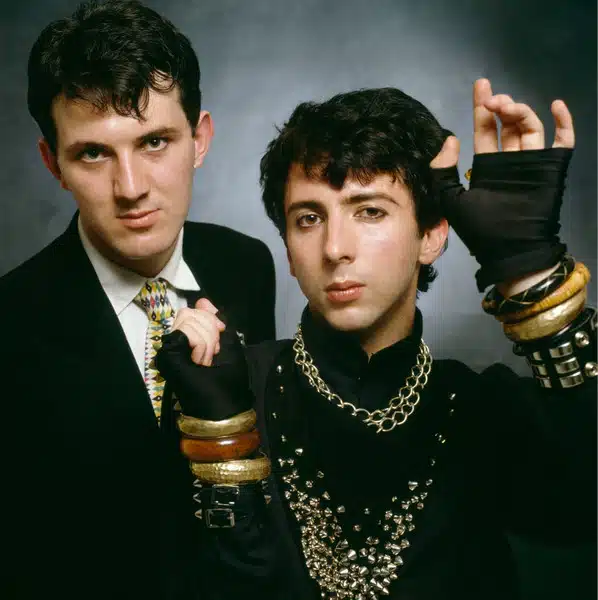

David Ball, the visionary producer and one half of the groundbreaking synth-pop duo Soft Cell, has died at the age of 66 from natural causes. Ball’s influence on electronic music — from the global hit “Tainted Love” to his later work with The Grid — helped shape the sound of the 1980s and beyond.
His longtime musical partner Marc Almond confirmed the news in a heartfelt statement:
“He will always be loved by Soft Cell fans who adore his music, and his memory will live on through it,” Almond said. “At any moment, somewhere in the world, someone is finding joy in a Soft Cell song. Thank you, Dave, for being such a huge part of my life and for the music you gave me. I wouldn’t be where I am without you.”
When Soft Cell disbanded in the mid-1980s, Ball co-founded the electronic dance project The Grid with Richard Norris, releasing several acclaimed albums — including the 1994 global hit “Swamp Thing.”
Norris also paid tribute, writing:
“Dave was such a huge part of my musical life for so many years. Being in a duo creates a special bond, and that’s what we had. We shared incredible experiences, laughter, friendship, and, above all, music. Thank you, Dave.”
A Legacy That Redefined Synth-Pop
David Ball and Marc Almond met in 1977 as art students at Leeds Polytechnic. Before they even became friends, Ball had already heard of Almond’s notorious live performances. “His main piece was called Mirror Fucking,” Ball recalled in a 2017 Guardian interview. “He’d stand naked in front of a mirror, cover himself in cat food, and… well, you can imagine. He caused quite a stir. He heard me playing with a synthesizer and asked if I’d make music for his performances. That’s how Soft Cell started.”
The pair began performing in small Leeds venues, including the Leeds Warehouse, where Almond worked the cloakroom. With a £400 loan from Ball’s mother, they recorded their debut EP Mutant Moments in 1980. A chance encounter backstage at the Futurama Festival led BBC Radio 1’s John Peel to play the EP on air, setting Soft Cell on their path to stardom.
Their big break came with a bold reimagining of Gloria Jones’ 1964 soul track “Tainted Love.” The duo transformed it into a dark, hypnotic synth-pop anthem that became one of the defining songs of the 1980s. Released in 1981 — just before MTV’s debut — the video’s heavy rotation propelled the song to No. 1 in the UK and across multiple international charts, cementing Soft Cell’s status as electronic music pioneers.
Soft Cell followed “Tainted Love” with a string of hits including “Bedsitter,” “Say Hello, Wave Goodbye,” “Torch,” and “What.” Though their U.S. success was more limited, the duo became icons of the New Wave era.
After splitting in 1984, Ball explored new sonic territories with The Grid throughout the 1990s before reuniting with Almond in 2000. The pair released Cruelty Without Beauty (2002) and Happiness Not Included (2022) and continued to perform at major 1980s revival festivals across Europe. Their final concert took place on August 16, 2025, at the Rewind Festival in Henley-on-Thames, alongside UB40, ABC, and Squeeze.
A Musician Until the End
According to Almond, Soft Cell had just completed a new album shortly before Ball’s passing.
“It’s terribly sad,” he said. “2026 was meant to be an exciting year full of new projects for him. I find some comfort knowing he heard the finished record and was truly proud of it. Dave’s music is more alive than ever — his melodies remain unmistakably Soft Cell, but he always found a way to push things further.”
“He was a wonderfully brilliant musical genius,” Almond added. “We were two stubborn art students who wanted to do things our own way — even when it was wrong. We were naïve, we made mistakes, but we saw them as part of the adventure. Dave and I were very different, and maybe that’s why our chemistry worked so well.”
David Ball’s legacy endures through decades of innovation — a testament to how two misfit students from Leeds changed pop music forever.