
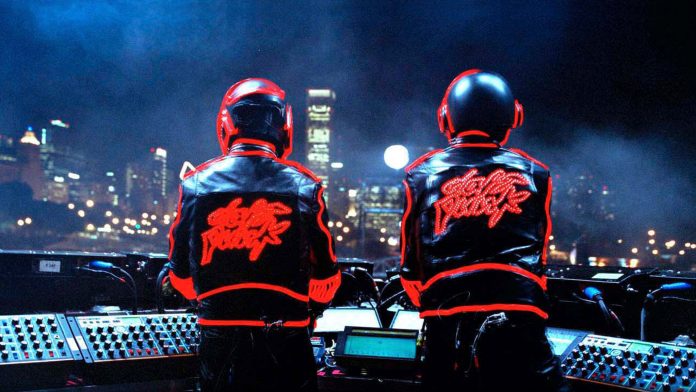

If music history had a short, aggressive heartbeat, Daft Punk would be the thump you still feel when a club goes silent. Thomas Bangalter and Guy-Manuel de Homem-Christo started as bedroom producers who flipped French house into global grammar. But their story is not a single album arc. It’s a trilogy of reinvention: the raw club aggression of Homework, the pop-alchemy of Discovery, the stripped robotic provocation of Human After All, the live-transcendence of Alive 2007, the cinematic reach into Tron: Legacy, and the elegiac goodbye of the 2021 “Epilogue”. Each move rewired how music, image, and spectacle collide.
Beginnings: Homework and a Club Revolution
Before the helmets became icons, there was Homework — 1997, loud, sweaty, skeletal, and absolutely necessary. Tracks like “Da Funk” and “Around the World” were not polished pop. They were club weapons. Homework made house feel immediate and slightly dangerous. While the world still associated electronic music with raves and niche scenes, Daft Punk translated it into anthems. Their approach was simple and radical: loops, grit, and an ear for hooks that stubbornly crept into mainstream consciousness.
That record established the duo as architects rather than imitators. It’s the blueprint DJs still tap into when they want to move a crowd without pandering.
Pop Mythmaking: Discovery and the Human Machine
2001’s Discovery arrived like neon in a blackout. Lush melodies, disco grain, pitched vocals — suddenly the robotic became romantic. “One More Time” and “Digital Love” blurred nostalgia and futurism, making the vocoder feel like a confession booth. Discovery retooled pop production. Sampling and electronic manipulation stopped being underground tricks and became a palette for mainstream songcraft.
That album wasn’t just hits. It was a mood board: anime-influenced visuals, glossy production, and an ethos that imagined electronic music as a full cultural package. When Kanye later sampled “Harder, Better, Faster, Stronger” for “Stronger” he didn’t just borrow a riff. He borrowed a lineage.
Provocation and Minimalism: Human After All
2005’s Human After All is the black sheep in a lot of Daft Punk retrospectives. Its aesthetic is rawer and more minimal than Discovery. Critics were divided at release, but that rawness is part of its point. Songs repeat like staccato mantras, often hostile, sometimes eerie. The album questioned authenticity in an era of glossy digital reproduction. Was it a misstep? Maybe. Was it influential? Absolutely. Producers who embraced austerity and repetition cite Human After All as a proof point that electronic music could be stripped back and still land like a punch.
The Live Revelation: Alive 2007
If Homework was their thesis and Discovery their manifesto, Alive 2007 is the proof. The live album and tour turned Daft Punk into a phenomenon defined by architecture of sound. They weren’t DJs in the back of the room. They were sculptors of live tension. Sets folded samples into massive crescendos, and the pyramid rig became as iconic as their helmets.
Alive 2007 changed expectations for electronic live shows. Instead of lip-syncs or laptop gestures, Daft Punk offered dramatic arc and communal release. From tiny rave rooms to stadiums, producers started thinking about live albums and tour narratives differently. The ripple effect is visible in every major electronic act that treats a set like a cinematic storyline.
Cinematic Reach: Tron: Legacy and Scoring Film
In 2010, Daft Punk crossed into cinema, scoring Tron: Legacy. They worked alongside a full orchestra to create a hybrid soundtrack that sounded like a club with an orchestra pit. The result was cinematic, emotional, and texturally distinct from their studio albums.
Tron proved they could translate their sonic vocabulary into film language without losing their identity. It also paved the way for electronic acts to score major projects and changed how studios thought about pairing electronic textures with blockbuster visuals.
The Goodbye and the Echo: Epilogue and Aftermath
Their 2021 “Epilogue” video left fans stunned. No PR tour, no interview to explain. One robot walks away, the other explodes. The silence afterward turned into a presence. Without new music, their catalogue became a blueprint for sampling and homage. TikTok filters looped arpeggios. Producers reimagined vocoders. Fashion that borrowed their chrome futurism kept returning to mainstream cycles.
Artists across genres — from Kanye to The Weeknd to younger producers like Fred again.. — openly borrow the duo’s playbook. That’s the real metric of legacy: when others use your tools to tell new stories.
Why It Still Matters
Daft Punk did more than make great songs. They built an ecosystem. They made anonymity stylish. They fused tech and soul. They taught pop to embrace mechanized emotion and taught clubs to crave narrative. Whether you came for the hooks on Discovery, the club grit of Homework, the mood experiments of Human After All, the live ecstasy of Alive 2007, or the soundtrack sweep of Tron, there is a thread: an obsession with transformation.
And their influence isn’t nostalgic perfection. It’s messy and ongoing. From TikTok edits to festival headliners, the duo’s fingerprints are everywhere.
Takeaway
Daft Punk’s story is not a straight line. It is a looping track that samples itself, rebuilds, and pushes the party forward. They broke rules, then rewrote them with a helmeted wink. Their exit was abrupt, but their signal never faded. If anything, it amplified. New producers will keep sampling that heartbeat for decades.
FAQ (for featured snippets)
1. What did Daft Punk change about electronic music?
They turned underground production techniques into mainstream songcraft, popularized the robotic vocal aesthetic, and set a new standard for cinematic live electronic shows.
2. Which Daft Punk albums are most important?
Homework for club foundations, Discovery for pop crossover, Human After All for minimal provocation, Random Access Memories for analog soul, and Alive 2007 for live redefinition.
3. Did Daft Punk score films?
Yes. They co-created the soundtrack for Tron: Legacy in 2010, blending electronic textures with orchestral elements.