


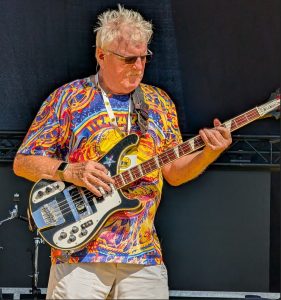
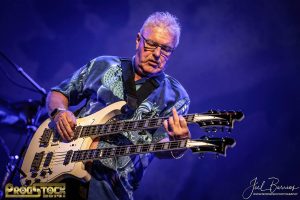
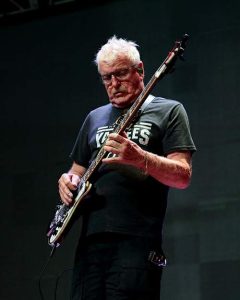
HIT CHANNEL EXCLUSIVE INTERVIEW: December 2025. We had the great honour to talk with a very talented musician: Derek “Mo” Moore. He is most well-known as the original bass player of progressive rock pioneers Nektar. During the ‘70s they released several classic albums such as “Journey to the Centre of the Eye” (1971), “A Tab in the Ocean”, (1972) “Remember the Future” (1973) and “Recycled” (1975). One of the bands that were influenced by Nektar were Iron Maiden who covered “King of Twilight” and “Cryin’ in the Dark” (both from “A Tab in the Ocean”) on their “Aces High” (1984) single. In 2024, they released their latest studio album called “Mission to Mars”. Read below the very interesting things he told us:
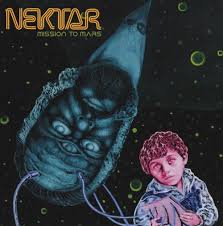 Would you like to describe to us the writing and recording process of “Mission to Mars” album?
Sure. This is the T-shirt (ed: he shows me the T-shirt with the album cover on Zoom). We wrote the album at Ryche’s (ed: Chlandra -guitar, vocals) house, we got all the basics and then we did the lyrics. Then, we took it down to the Shorefire Recording Studios and we recorded the basic tracks in two days with the drummer. The drummer (ed: Jay Dittamo -Jimmy Webb, Chuck Berry, Ryche Chlandra & Flying Dreams) played with us for the first time in these two days when we did the basic tracks and then we took the basic tracks back to Ryche’s house and Ryche put all the guitars on and Kendall (ed: Scott) put all the keyboards on. Then, we went back to the Shorefire studios and mixed it. Then, we sent it to Sydney, Australia for the mastering and we mastered it separately for vinyl than the CD; there are two different masterings. That was it, that was the process. We were writing the music for over a year putting in a bit singing, doing rehearsals and took it where we wanted it. We are in that process right now, we are writing the next one. Did you like it? Which is your favourite track?
I listened to it many times. My favourite track is “I’ll Let You In”, the last one.
That was successful in the Christian market over here, as well. That’s a good song. We got a good feedback on this album. Where are you living in Greece?
Now, I’m in Peloponnese, near Ancient Olympia.
Many-many years ago we were in Athens, Greece. We played concerts in Greece in Athens and we played for a month on the island of Spetses, long-long time ago, in 1966.
With which band?
That was the band before Nektar, called The Prophecy.
 Good to know. How emotional was it for you to complete “Mission to Mars” without Ron Howden (drums) who suddenly died from brain aneurysm?
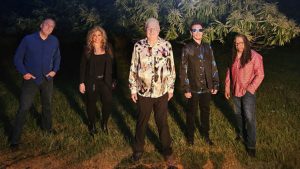
Well, we had the demos done, so, we knew what we were gonna do and Ron came the day before he died, actually, on the Sunday and we gave him a phone drive with all the new songs on it and he said: “Good, I’ll take this and I’ll put it together and we’ll come and record it” and the next day he died. So, we had a lot to go through and then we decided to look for another drummer and we found another drummer, Jay Dittamo, who used to play with Ryche and Kendall in a band called Ryche Chlandra & Flying Dreams. We brought him up to Ryche’s studio and we got the tempos of the songs down, so we got the feel that we were looking for and then we booked a real studio, where we did “The Other Side” (2020), a few years ago. Joe DeMaio (Shorefire studio) is an awesome engineer, so, we went down there and we did the basic tracks in two days and added a couple of guitars. Then, we took it back to Ryche’s studio and Ryche put all the guitars on and he gave it to Kendall and Kendall put all the keyboards parts on and then we took it back down to the studio and we put all the vocals on and did the mix. Vocals are better in the studio because you focus on just what you are doing and we wrote all the words before we go down there. We added some words down in the studio but the main lyrics were all written; Ryche and I did all the lyrics before we took it down there and then we put the vocals on it. Then, we did the mix, we listened to different mixes until we decide on the one that we were gonna use and we sent that to be mastered in Sydney, Australia. The guy (ed: Leon Zervos) used to be in New York City, he moved to Australia but it doesn’t matter, we sent it to him. It’s good. “I’ll Let You In” it’s a great song.
How did “I’ll Let You In” come about?
Ryche was playing about with his guitar and the idea for the song came to him and in a few minutes he played what you hear and so, all we had to do was put lyrics on it, really. I put the bass on it and got the feel for it and we had to write the lyrics, which we did. And the lyrics came to us all in one day. We sat at this kitchen table writing lyrics and it’s very emotional, actually. The song is a very emotional song.
It seems that you are very happy with the current line up of Nektar, aren’t you?
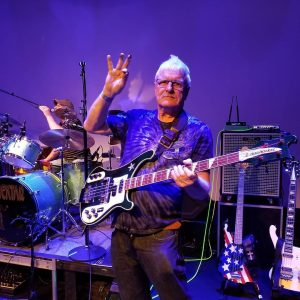
Yes, very good line up. We are gonna go out and do a couple of gigs at the end of January: One in New York and one in New Jersey and then we are planning a tour in April. On the tour we’re gonna do the whole “Mission to Mars” and some of the original stuff, “Remember the Future” and a bunch of older songs.
 Will you release the next Nektar studio album soon?
Not soon because we ‘ve got to sort out the record company and we need money to do the production which is gonna be set up really soon. I would think by autumn, by August-September we should have it done. It takes time, you know.
My favourite Nektar track is “Burn Out My Eyes” from “Journey to the Centre of the Eye” (1971). Please tell us everything we should know about this amazing piece of music.
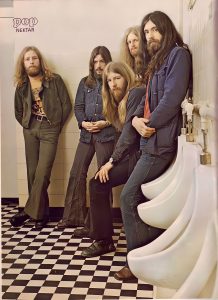
Yeah, a lot of people like that. That was the first thing we wrote. Well, we wrote a bunch of other songs that appear on “…Sounds Like This” (1973) and we did “…Sounds Like This”, so that we are free to do “Remember the Future” (ed: later in 1973), but we wrote the space opera “Journey to the Centre of the Eye” probably in the ‘60s. “Burn Out My Eyes” was part of something that I wrote in Istanbul in ’66 and me and Roye (ed: Albrighton -guitar, vocals) put that together and it’s a good piece of music.
What memories do you have from your collaboration with Robert Calvert (Hawkwind vocalist) on “Down to Earth” (1974) album?
“Down to Earth” is coming out again! “A Tab in the Ocean” came out just now in a box set and “Down to Earth” is coming out in February. The new 2025 mix of “A Tab in the Ocean” is awesome! When we did “Down to Earth” we needed a ringmaster and we asked Robert Calvert: “Do you want to play ringmaster in this?” He said: “Sure”, so he came down the studio and he had us in stitches; he was so funny! And all the words that he did were all ad-lib, just out of his head. Boom! He was a great guy, he was fine. When we played in London, after “Down to Earth”, I looked to see if he would come, but he died a couple of weeks before, I didn’t know. He was definitely incredible.
 Did you feel a bit surreal when you saw George Martin (The Beatles producer) watching Larry Fast (Peter Gabriel, Foreigner) recording the Moog Synthesizer on “Recycled” (1975) album?
No, that was good. He really liked it. He spent a lot of time in the studio listening to “Remember the Future” when we did the mastering of that there (ed: AIR Studios) and George Martin really loved it. So, when we brought in “Recycled”, he came into the studio and Larry Fast was putting the timpani on and a lot of tones are not real, he played it on synth, sort of out of tune, but in a special way. Larry said: “Do you have a synthesizer?” and the (ed: studio) guy said: “Yes, of course, I have a synthesizer” and he pulled out a Korg, I think. Larry set up the keyboard, got everything going and he said: “Ok, I’m ready” and the engineer said to him: “Do you wanna hear it?” and Larry said: “No, that’s it”. He knew what it was. Larry is a genius. So, we had him doing these different sounds and he sounded absolutely wild! George Martin was enthralled, he just stood at the back of the studio saying: “Shit, man, this is really good”. When he put the last layer on and you could hear the steel drum, it was incredible. Larry is definitely a genius for that stuff.
What was your first reaction to Iron Maiden’s cover to “King of Twilight” and “Cryin’ in the Dark” (both from “A Tab in the Ocean” -1972) on their “Aces High” (1984) single?
We liked it, we were happy with that and we got royalties for that. Steve (ed: Harris -bass) is a really big fan of the band. I thought it was a good version and I’m glad that they included it on the single, that was really good for us because they were much bigger band that we were, you know.
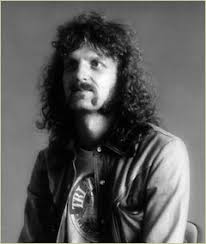 Do you believe that Pink Floyd in “Shine On Your Crazy Diamond” (1975) copied Nektar’s “Remember the Future (Part 2)” (1973) ?
I know that Larry called me and said that the new Pink Floyd is out and there is a part that they “borrowed”, if you like, a guitar part that was definitely copied from what Roye did, two years earlier. Yeah, you are gonna be flattered with stuff like that, I don’t believe in “Oh, we are gonna sue him because he used our music”. It makes the music more wildly thought of, you know. I met David Gilmour (ed: guitar, vocals -Pink Floyd) earlier when they were doing “Dark Side of the Moon” (1973), actually. Really nice guy and a really good guitarist. David Gilmour was in the studio doing some work on “Dark Side of the Moon” and I went into the studio and I saw him and I talked to him for a little bit and he was pondering about. They just came in the studio. When we put the band back together in 2002 in New York, Nick Mason (ed: Pink Floyd -drums) flew over just to see us, that was good.
Robert Fripp (King Crimson) played guitar on “Train from Nowhere” (from “Magic is the Child” -1977). How did it happen?
Robert was in the studio, he was doing something, I don’t remember what, but he was doing something in the studio and I saw him. I knew him from Paul Higgins, who was our engineer, he was also Robert’s engineer and I met him at Paul’s wedding. So, I said: “Hey Robert, we are in the studio, we are doing a new album. Can you play something on it?” He was all very secretive about it and he played a section with Frippertronics (ed: tape looping technique that he invented). He just did it and he left it for us to listen to it. He recorded it on his own and he didn’t want to be recognized, so, we called him “Walt Nektroid” (laughs). On the album, it says “Walt Nektroid” and that is actually Robert Fripp.
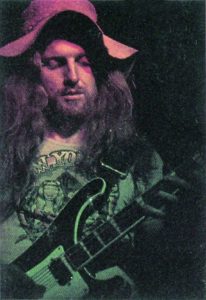 How emotional was it for you to reunite with the other original members at NEARfest in 2002?
It was good. You know, I got a call: “Do you want to do it?” and I said: “Sure, why not?” and we put the band back together and rehearsed every Sunday. We each had a CD of what we are gonna play from a live version and we all played it individually at home to get the sound and the rest of band, me, Taff (ed: Allan “Taff” Freeman -keyboards), Ron (ed: Howden -drums), two girls (ed: Michelle Eckert and Maureen McIntyre -female vocalists) and percussionist (ed: Scott Krentz), we got a rehearsal studio and we rehearsed every Sunday until we got to the point Larry (ed: Fast) came in and played with us. Then, the last week before the festival we went in Vinnie’s studio -Vinnie (ed: Schmidt) was our sound engineer- and we played for a week and then we did the gig. It was really good, we played for 3 hours!
Who are your influences as a bassist?
Certainly, Paul McCartney. We play very similar style, very melodic. I like Tim Bogert from Vanilla Fudge very much. I’ll tell you a funny story about Tim. When I retired (ed: after 1978), I went into the plumbing and heating business, and I was at a house looking at a boiler and the lady in the house said to me: “Oh, I have a cousin who plays music” and you hear that a lot: Everybody’s got a cousin that plays music and I said: “Who’s your cousin?” and she said: “Tim Bogert” and I almost fell on the floor and she said: “Look, in the kitchen, that’s his mother. She’s making food”. I got to meet her and I said: “Listen, if Tim ever comes to town, call me and I’ll come down”. Maybe two months later, she called and I went down and we spent probably two or three hours talking. Great guy and a great bass player! When we put the band back together, we did a festival in Germany and we were headlining Saturday night, Eric Burdon was headlining Sunday night and Friday night, Vanilla Fudge was playing. So, we went down to see everybody and I saw Tim tuning his bass. I went down and tapped him on the shoulder and I said: “Tim, it’s a long way from Chester”, that’s where we met and he looked round and said: “Wow, what are you doing here?!” It was good. He was a great guy!
Did you like other bass players from your era like Jack Bruce (Cream) or John Entwistle (The Who) ?
Yeah, they are all very good bass players. Very good bass players! You have a style and things influence you; what sounds good, it could be something orchestral. It’s the way it blends. I play very much melodic, often cello-like. I was a piano player. I started off playing piano and I went to bass from that. I like playing bass, it’s a good instrument.
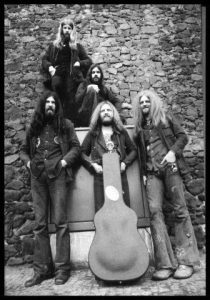 What makes the music of Nektar still relevant in 2025?
I don’t really know. It’s relevant. It’s certainly Nektar music; music that sounds like Nektar. It’s basically me and Ryche; Ryche was in the band in ’78. All the music for “The Other Side” (2020), was pretty much written in 1978, and we brought the music into the studio. We got the band together and we played in a studio for almost a year before we were ready to do something with it and that became a double album, that was 8 tracks. I like that album, it’s a good album. We are gonna re-release it. We did a concert (ed: in 1978) with a lot of the music that we wrote with Ryche and I have a recording of it, so, when we put it out, we are gonna put it out with the recording and what it was before. That’s probably not going to happen until sometime next year, I’m working on that. It was a concert we did and actually Roye came. Just for that concert, we played with Roye and with Ryche. Ryche was 21, I think, back then, but it was a good concert and we are gonna use that when we will release it again.
Had you realised in the ‘70s that your concepts about aliens and ecology were way ahead of your time?
That’s where our heads were at. I mean, look at what we are doing now, “Mission to Mars”. Now we are out in the space again and we are looking for where are we gonna go with the words on the next album and hopefully it’s gonna be a trilogy. We are gonna do an album and then another one. I have to have a look and see if we can do it all together and release it as two parts. That maybe will end up doing, yeah.
What was the secret of the amazing chemistry you had as rhythm section with Ron Howden?
I played with Ron for over 60 years. Whatever I was thinking, he was thinking the same, we were very, very tight. He was tough, he was against using a new drummer, however Jay Dittamo is an excellent drummer and he was picked by Ron. Ron picked him to follow him. Ron knew he had cancer and he was afraid something would happen to him and he saw him playing and he walked up to him and said: “If ever I can’t play, I’d like you to play in my place” and that’s exactly what happened. We had an audition for drummers and as soon as he came in, I knew he was the guy.
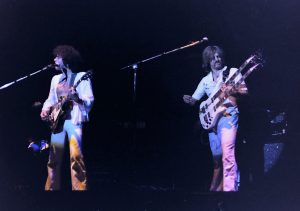 Why do you consider Nektar a part of krautrock scene?
Because we lived in Germany for 11 years, I mean, I speak German. The thing is we used to have festivals, possibly once a month; big festivals with bands like Karthago, Guru Guru and Epitaph, all these bands. We ‘d get together, we’d play a festival and we’d all get some money out of it and I guess it became the krautrock scene, but krautrock just talks about the rock in Germany. I know Amon Düül II didn’t like that, they didn’t figure they were krautrock. They are big friends of mine.
They were way ahead of their time, too. I think their album “Yeti” (1970) was even more ahead than King Crimson.
Yeah, it was good… I actually learned to speak some Greek from a Greek guy who spoke German. I learned some, so I could speak on the telephone. It’s been a long-long time. I’m going back to ’68, the last time I spoke Greek, but what a great place! Do you know Vangelis?
Yes, of course.
Yeah, we used to go at Vangelis’ house and play.
In Athens or London?
In Athens. We were supposed to be Aphrodite’s Child with Demis Roussos (ed: vocals, bass), me and Ron, the drummer, but we were in the middle of doing something and the timing didn’t work.
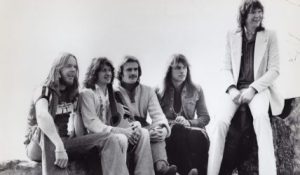 Did you get to play with Demis Roussos?
Yeah, I knew him well. Now, they are both gone. They were good. We played big concerts in Greece. We played the Panathinaikon Stadium in Greece, 60.000 people. It was great. The Greek people had nobody to listen to, there were no really big concerts and when we came down there, it was like we were The Beatles. Suddenly, we were playing music that they wanted to hear. I’m trying to remember the guy… Nico Mastorakis, I think. He did the concerts.
He is a bit controversial figure in Greece.
Definitely, very controversial. What is he doing now?
He owns a radio station and makes films, documentaries, etc. He is a director.
I would love to come and play in Greece. That would be good.
Did you listen to Karlheinz Stockhausen as many bands of your era did?
Yes, we did. We actually went to a concert of Stockhausen and if you listen to “Journey to the Centre of the Eye”, there are sections on there that are very Stockhausen, that we got the influence from Karlheinz. He became of a friend of ours, he was a great guy.
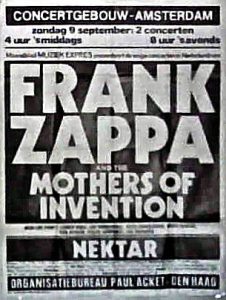 Did you get to know Frank Zappa when you toured together?
Yeah, very well. Frank was another great guy. He put us on his tour. He really wanted us to be on his record label but we had already got a contract, so we couldn’t do that. Frank liked the band a lot. The two bands were great together, we toured the whole Europe with him. It was great, I loved it.
Were you surprised when you saw a photo of Ian Curtis (Joy Division singer) wearing a Nektar t-shirt?
Yeah, yeah, yeah! I saw that! I was! “George Jefferson”, Sherman Hemsley (ed: the actor who played George Jefferson on “All in the Family” and “The Jeffersons” TV series), he went on Hollywood squares with the Nektar t-shirt.
How much did the political atmosphere in 70’s West Germany affect the music of Nektar?
Not at all. We weren’t political.
It was very hard not to be political back then.
You know, the problem with politics is: If you agree with one side or the other side, you lose the audience from other side, so, you only have half an audience. I don’t believe that’s the way to go. Music and politics don’t mix. They don’t mix. When we were in Greece, (ed: Georgios) Papadopoulos was the guy back then.
The dictator, the colonel.
Yeah. I remember, I shouted in his car because he was honking his horn and they came and picked us up and took us to a court and we had to get out of Greece (laughs). It was a hell of time. ’68 it was. I think we were in Greece in ’66 and ’68.
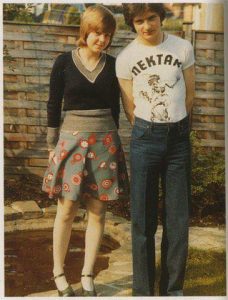
Was there in the ‘70s any kind of competition between Nektar and Eloy?
No, no. We were friends. All the bands: Eloy, Epitaph, Guru Guru, we were all really good friends. It wasn’t competitive. Tangerine Dream…
How did you get Tangerine Dream their first record deal with Virgin?
I went to Virgin Records and I talked to Richard Branson (ed: the owner of Virgin Records) and Richard said to me: “I’m looking to try get hold of Tangerine Dream” and I said: “Well, I’m playing with them next week, so, give me a number and I’ll give it to Edgar (ed: Froese -Tangerine Dream keyboardist)” and I did that and they got the gig with Virgin. Richard Branson was a good guy, too. He is a billionaire today.
What was the greatest skill that Roye Albrighton (guitar, vocals -died in 2016) had?
He was a great guitarist. He was a fabulous acoustic guitarist, he played great acoustic guitar. Roye was super-talented. We used to write music every day and Mick (ed: Brockett – lyrics, light show) and I would do mostly lyrics. Roye was a really great musician. I met him at The Star Club in Hamburg; we were playing at The Star Club and they were playing at The Star Club. Many bands played there: Black Sabbath, Spooky Tooth, Ace Kefford (bass) from The Move, great band. Bev (ed: Bevan -The Move, ELO, Black Sabbath) is a great drummer. I know Bev from London, he was a great guy.
You optimistic about the future of progressive music?
Yeah, I think progressive music slowly is coming up. I know we have been lumped into that as progressive music but I don’t know if that is progressive music. I don’t know. I don’t like being lumped into “this is the way you are”.
Yes, but your music is definitely progressive.
I’m sure, I’m sure! But we were around a long time before progressive music was around. We were a rock ’n’ roll band. If you listen to “Journey to the Centre of the Eye”, there is a lot of really heavy rock stuff in there.
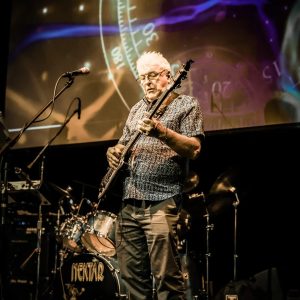 Is “Do You Believe in Magic” (from 1970’s “Boston Tapes”, bonus to “Remember the Future”) the most Beatlesque song you ever wrote?
I think yes. “Do You Believe in Magic” is definitely Beatlesque. A lot of our music has that edge. If you listen to some other stuff like “Skywriter” on “The Other Side”, you can hear the influence of George Harrison on Ryche. We are all big Beatles fans.
Does “Live In New York” (1977) live album capture the true spirit of a Nektar concert?
I think so, yes. I’ll tell you that “Sunday Night at the London Roundhouse” (1974) is very good, too.
Could we say that the artist Helmut Wenske is Nektar’s Roger Dean (Yes, Asia album covers) or Storm Thorgerson (Pink Floyd, Scorpions, UFO album covers) ?
Absolutely. He is fantastic, he is a real artist. He is in his mid-80s now. Great guy, we talk at least once a month. He is not painting anymore, he’s got arthritis in his hands, but yeah, he is definitely our Roger Dean.
In Jimi Hendrix’s music, in George Harrison’s music, in Santana’s music, there is also a very strong spiritual aspect. Is today’s music spiritual?
“I’ll Let You In” is definitely spiritual. I think there is a lot of good spiritual music, I do. There is a place for all music, depending on what you want to listen to. I think when people listen to our music, most of them will like it, but they’ve got first to hear it and that’s hard. We are working on that very hard.
Do you think because of the streaming services listening to an album from start to finish is now becoming a kind of lost art?
Yeah, I do. I think the kids today, they download everything.
 Yes, but I listen to each album 20 times from start to finish. Now, the kids listen to a song once for 30 seconds and they say “I like it” or “I don’t like it”. They don’t listen to the whole album. I did an interview with Keith Emerson and he told me: “It was a huge event when The Beatles released a new album. You should listen to John Lennon’s lyrics. You should listen to George Harrison’s guitar. Nowadays nobody gives a shit about who plays the guitar solo on a Lady Gaga album. Music in the past was more important to people”.
You are right, you are right. I think that’s a problem, really: Trying to get the music out to the people, is getting people to listen to it. They don’t want to buy an album, they want to download from Spotify and Spotify pay peanuts and you end up not making any money as an artist. It’s very tough. The big difference today than in the ‘70s when we were playing, by then, people wanted to buy albums, vinyl; there were no CD’s yet. Once the CD came out, I said to Larry Fast, “Sooner than later, you’ll just download to the computer and we will be cut out” and that’s exactly what happened. If you are selling 6.000 albums today you are in the charts, and it used to be at least 50.000-60.000 albums to get into the charts. We have albums that sold 100.000 or 200.000 copies. “Remember the Future” sold that, no problem, but since “Remember the Future” I don’t think anything sold as well. Over the years, the sales have dropped. But as I said, people don’t buy albums today, they don’t buy CD’s. When we went on tour with “Mission to Mars” we printed 200 special CD’s just for the tour and they all sold out, but that was our crowd and our gigs. I think “The Other Side” sold more, they sold around 6.000 albums and we made the charts with that and we made the charts with “Mission to Mars” as well, but not really enough to make any money on it. It’s tough today, something’s got to give.
All you progressive musicians how did you feel around ’77 when the punk rock came out?
Punk rock wasn’t my thing. I can deal with punk rock, I can’t deal with rap. Rap doesn’t do anything for me, but punk rock it’s just rock ‘n’ roll in a different form.
You have toured with a lot of people. Who is the nicest person you have ever met?
That’s a heavy question. Lots of people I’ve met are super people. My office manager, when I had Nektar management in Germany, just called me the other day, he’s coming here actually today, but he got ill on this trip and he had to go back to Germany. So, lots and lots of people would rate very highly for me.
Had you ever met any guys from Can?
Yeah, I knew Can from the days in Cologne, they were Cologne-based I believe.
Had you ever been to UFO Club, where Pink Floyd played when Syd Barrett was in the band?
We played a concert with Syd Barrett at the Cambridge Corn Exchange, his last concert (1972) with The Pink Fairies drummer, Twink. I know Twink well.
I’ve talked with him. Twink said that Syd’s madness has been definitely overplayed, he wasn’t as crazy as people say. You met Syd, what was he like?
He was very spaced out, very much spacey, you know. I don’t think that was one of his best concerts. I think he did good things with Pink Floyd. He had some great ideas but some drugs took his mind.
 One of my heroes is Steve Marriott (Small Faces, Humble Pie -vocals, guitar).
Oh Steve was good. Stevie was a great guy. I met him with Small Faces. He was great guitarist and had a great voice. I thought he would have been a lot bigger than he was. When the Small Faces broke up, it was like he disappeared. Peter Frampton (ed: Humble Pie -guitar) right away came over to the States and he became huge. He is still huge over here.
What was it like to live in ‘60s Swinging London?
It was good, it was a lot of fun. We used to go to The Speakeasy (ed: club) and everybody was there, it was who’s who of musicians down there.
John Lennon, Keith Moon (The Who -drums) and Ginger Baker (Cream -drums) used to go there.
I never met them, I was never in the same place. I met Pete Townshend (The Who -guitars) one time but I never met Keith. Keith was great (laughs). I actually did meet John Entwistle (ed: The Who -bass), he was a great bass player. He was playing down at Abbey Road, he was doing a gig with Ann Wilson (vocals) from Heart. It was like what Ringo does now with his band (ed: Ringo Starr & His All-Starr Band, consisted of other famous musicians). That came from that. Ann Wilson is also an awesome vocalist. We didn’t talk about bass with John Entwistle. I knew Chris Squire (ed: Yes -bass) pretty well, we never got to talk about the music either. We just talked about “Hey, what are you doing?”, “How is the concert going?” With Tim Bogert, we talked a lot about music. We talked for nearly 3 hours, so yeah. He was teaching at Berklee Music School at the time. He really knew his music. Also, I knew Jimi Hendrix quite well. I met him in Frankfurt and then we were in Hamburg and I met Jimi again at The Speakeasy in Hamburg and we sat together and we were listening to the “Abbey Road” (ed: The Beatles -1969) album that had just come out. We both agreed that it was a great album. So, when it was time for him to go home, I said: “Come on, I’ll give you a lift” and I gave him a lift back to his hotel, but I didn’t see him after that. I met him two or three times, he was a very humble guy.
 Brian Auger (Oblivion Express, Trinity -keyboards) was very good friends with Jimi Hendrix and he told me that the last time he met him he was very heavy on drugs.
Oh yeah, very heavy on drugs. When I knew him, he was OK with cognac and coke, something like that. He would put the coke in the bottle under the table. We smoke hash together in Hamburg. He liked that. He was a good guy, he was not at all a big-headed. He was a down-to-earth guy.
Another great bass player was John Paul Jones (Led Zeppelin). Had you ever met him?
John Paul Jones was a good bass player, yeah. I met him, we were backstage when they played at Wembley in London (ed: 20 & 21 November 1971) and we had long discussions with Robert Plant (vocals). Robert Plant sat down and he was like one of the gang, you know. It was great. We were supposed to play with them, but they couldn’t get us on the bill because they had too much happening. So, we were backstage and I met Jimmy Page (guitar). I knew Jimmy from years ago, from ’64 when he was playing with Little Richard. He was actually a bass player for Little Richard. I met John Paul Jones, but we didn’t really talk because I was talking to the rest of the band.
A huge “THANK YOU” to Mr. Derek “Mo” Moore for his time.
Official Nektar website: https://nektarsmusic.com
Official Nektar Facebook page: https://www.facebook.com/nektarRocks