

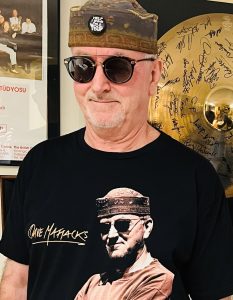
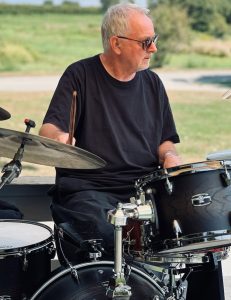
HIT CHANNEL EXCLUSIVE INTERVIEW: August 2026. We had the great honour to talk with a legendary drummer: Dave Mattacks. He is best known as the drummer for Fairport Convention, a role he has held intermittently since 1969. He has also played with Nick Drake, Paul McCartney, George Harrison, Jimmy Page, Elton John, Brian Eno, Jethro Tull, XTC, John Martyn, Richard Thompson, David Gilmour, Feast of Fiddles, The Albion Band, The Incredible String Band and many others. Fairport Convention will perform at their annual Cropredy Festival, taking place this year from 13 to 15 August. Read below the very interesting things he told us:
What should fans expect from the upcoming Cropredy Festival on 13-15 August?
Well, it’s always a really good festival. The atmosphere is wonderful, it’s been going for a very long time and I don’t really know what else to add (laughs). All the information is on the Fairport Convention website. If anyone in the UK is reading this and doesn’t know about it, that’s the best place to go.
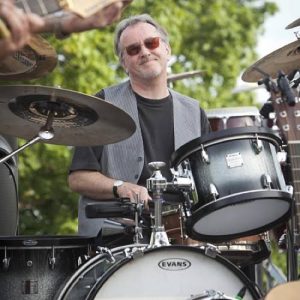 In 2023 you returned to Fairport Convention. How emotional was it for you to rejoin the band?
It was really enjoyable. It was a double-edged experience because, when I left in ’98, one of my best friends and a wonderful, wonderful drummer -who I was and continue to be, a big fan of- Gerry Conway took my place. Gerry very sadly became ill and unfortunately, passed away. So, on one side of the equation, it was very sad because, prior to Gerry Conway’s passing, we had enjoyed many great times at Cropredy over the previous 10 years or so. We had shared drumming duties and even done some double-drumming. Generally speaking, I’m not a fan of double-drumming, but when you’re playing alongside someone as great as Gerry, who listened -and hopefully I did too- nobody gets in each other’s way. So, that was very enjoyable. On one side, it was very sad; on the other, it was really good to play with my friends again, some of whom I’ve known for nearly 60 years.
In your opinion, what makes the music of Fairport Convention still relevant in 2026?
I think, in part, because we never really followed fashion. That’s one aspect. Another contributing factor is that we’ve always eschewed any kind of -for want of a better word-“rock stardom”. I know that’s a bit of a cliché, but the band has always been so far removed from the pop and rock world. We were like that when we were young, so it’s not just a question of getting older. I’ve always had a very healthy dislike of the whole rock stardom thing. All the musicians I look up to -with a couple of obvious exceptions, like Keith Richards- aren’t rock stars; they’re musicians. To go sideways from this answer, when people say to me: “Oh, I understand you’re in the music business”, I say: “No, Madonna is in the music business; I’m a musician”. So the band unconsciously kept away from that side of things and I think there’s a small handful of people out there who appreciate that.
The band is very approachable off stage; there’s no rock star lifestyle. Another contributing factor -although most musicians in a band are probably going to say this- is that I think our music is worthwhile. We took, not originally but by the time I joined, English traditional folk music, shook it by the neck a little and electrified it. I know we encouraged other bands to do the same. Los Lobos are a prime example. David (ed: Hidalgo – vocals, guitar) once told me they thought: “If these guys can do this with English music, we can do it with Mexican music”. I’ve heard similar things from musicians in other European countries as well. Instead of always looking to the States -not that there’s anything wrong with that- they started looking at their own culture, without any kind of bullshit flag-waving, and asking: “What can we create, rather than just being another blues band?” Again, not that there’s anything wrong with that either (laughs). That’s a very long, winding answer, but there are a lot of contributing factors.

There’s nothing specific. When I’m at home in New England, I play with friends locally. Once in a while, I might do something “important” in a theatre, but I enjoy playing with friends in small music venues. I also still have a healthy handful of people who ask me to play on their records. As you’re probably aware, the days of getting a lot of people together in one recording studio to make a record -I wouldn’t say those days are gone, but they’re certainly not feeling very well. The whole aspect of remote recording has been a challenge for me and a lot of my peers. I’ve taken it on board, and I think I’ve learned how to do it. It’s another set of skills that you try to acquire. Like I said, I still get contacted by people who ask: “Would you play on my record?” Sometimes the tracks are already finished; other times, I’m involved right from the ground floor. It might just be a demo with someone singing and playing an acoustic guitar, but there are all kinds of variations. I’m very flattered that, at my advanced age, people still ask me to play on their records.
Are you proud that “Liege & Lief” (1969) is considered one the greatest albums of all time?
I’m proud of it as a record. I don’t know that it’s one of the greatest records of all time (laughs), but I think it’s a very good record. When I occasionally listen to it -if I’m doing some homework because Fairport have decided to play one of the tracks- I’m always struck by two things. First, I think the material is good. But, on the other hand, I hear a very inexperienced, very green drummer trying his best to keep up with the rest of the band. So, again (laughs), it’s a double-edged sword. I’m proud of the record, and I think it’s a very good one. I know that, in some circles, it was something of a trailblazer, but when I listen to it, I hear a very inexperienced drummer. That was a very long time ago. It is what it is, and hopefully I’ve grown up since then.
How important was the influence of The Band’s “Music from Big Pink” (1968) on “Liege & Lief”?
It was big. It was, again, that sensibility of listening to a group of musicians who truly encapsulated what is now commonly referred to as “Americana”. There are all kinds of influences in there, but it wasn’t just one influence; they really covered a lot of ground. What I always come back to is that it was done with such great material. I don’t care how good or bad the musicians are; if you’ve got great material, to me, that’s the number one thing. So the material, the songs, are absolutely fantastic. The other thing that I learned from all of those musicians, but obviously from Levon (ed: Helm – drums, vocals, mandolin), was no grandstanding: How to listen and how to really interpret the soul of songs. Just to elaborate: if people say to me today “What kind of drummer are you?”, I just say: “I like to accompany people”. I think where I’ve got a certain amount of ability is in accompanying, in playing a song. I’m not going to be a great jazz-rock fusion player, and I’m not going to be a heavy metal player, but I know how to play a song. I’m still learning, but I think that’s my strength. I think that because The Band, on “Music from Big Pink” and the brown album (ed: “The Band” – 1969), had those aspects of great material and no showboating, that definitely had an influence on “Liege & Lief”.

She was a phenomenal singer, and she was also a really, really great songwriter. She played really good piano and guitar. I mean, she was the whole package; she really was. Because she was so great and so unique, I think that was very much why, after “Liege & Lief”, there was no attempt to replace her with another singer.
Led Zeppelin jammed with Fairport Convention at the Troubadour Club in LA on 4 September 1970. Do you remember that night?
Very well, yeah. It was great. I mean, those people are all friends. I just saw Robert (ed: Plant – vocals) a few months ago. I haven’t seen Jimmy (ed: Page – guitar) for a while, but you may know that Jimmy asked me to play on the soundtrack for “Death Wish II” (1982), so we know each other. The thing that I learned from that night most of all, as well as it being an exciting little evening because they had just played a huge stadium and then came down to the club to sit and play with us, was something I discussed with John Bonham (drums): It was a real education in drum tuning. This is a little drum-technical talk, which I hope you don’t mind, but I was sitting behind what I thought was my perfectly tuned drum kit. What I didn’t take into account was one of the golden rules of tuning: The pitch you hear drops the further away you get from it. I had three tom-toms and I thought I had them tuned well, the same with the snare drum and the bass drum. I thought they sounded good. When John played them -OK, he played them a little bit harder than me- it just sounded like one very soggy tom-tom. There was no life in the drums, and back then the drums weren’t miked; there were no microphones on them.
When I went to the back of the club, the drum sound was just terrible, and certainly it wasn’t the playing. That’s when I started to become much more conscious about tuning to the room and also about the point I mentioned earlier: The pitch you hear drops the further away you get from it. If you tune a drum and you think you’ve tuned it to a good pitch, by the time you hear it at the back of the room without microphones, it’s going to sound like a baby’s arm hitting a pillow. It’s one of the many things that I’ve learned over the years with recording. When you hear yourself back and hear how your drums sound, what you think they sound like when you’re playing them sometimes doesn’t translate well to a recording, and it might not translate well to live playing either. It depends on the room, the acoustics, and how many microphones you have on it. So (laughs), that’s a very long, winding answer to your question about what I remember about that night. It was over in about -I don’t know- half an hour, but it was very enjoyable. That’s one of the many things that I remember well. Going sideways, if you’ve read Dave Pegg’s (ed: Fairport Convention – bass) book “Off the Peg” (2018), he talks about that night and basically how he and Bonzo went out on the town afterwards.
And John Bonham missed the flight to Hawaii.
Yes, he missed his flight. Peggy was actually drunk under the table. It’s quite a story.
I’ve heard that when John Bonham sat behind your drum kit and hit the bass drum, it moved forward a foot.
There are a lot of myths about that evening: That every time he hit the bass drum it moved forward, that he ruined the kit, blah-blah-blah. All he did was dent a couple of heads -that’s all that happened. He dented a couple of heads, and he played great, as he always did. There are a lot of myths about that. But, as Mark Twain said: “You never let the truth get in the way of a good story”.

Yeah. Back then, you went into the studio, the artist went through the song a few times, showed it to you and you recorded it. It was very apparent that Nick was very special. I mean, the tracks on that record are all live performances; there’s hardly any overdubbing. The string sections were overdubbed, I know Richard Thompson (ed: Fairport Convention – guitar) overdubbed the occasional electric guitar here and there and John Cale (ed: The Velvet Underground) maybe added some parts. But basically, what you hear is a live vocal and a live guitar from Nick, accompanied by a rhythm section and other instruments. There was no constructing, one instrument at a time. It’s almost the antithesis of what they do today. I’m not saying one approach is better than the other, but those tracks were cut live -most of them were recorded live.
What was Nick Drake like in the studio and out of the studio?
Beyond shy. He was incredibly shy. Obviously, he was also incredibly talented, but he was really shy -very, very withdrawn. It was painful when he played live because he had no real ability to interact with his audience. Only a small handful of people at the time understood how great he was because he wasn’t “delivering” the song. His live dates, generally speaking, weren’t that well received because of his shyness, because he was so withdrawn.
John Martyn’s “Solid Air” (1973) is one of my favourite albums. Is there any interesting story from its sessions?
John Martyn, as a personality, was almost the complete antithesis of Nick. John was truly larger than life. I remember a little bit about those sessions. I think that was one of the first sessions I had done with Danny Thompson (ed: Pentangle, Richard Thompson – double bass). Again (laughs), it’s not false modesty, but when I listen to those recordings, I hear a very green and inexperienced drummer. But it is what it is. To reiterate, it doesn’t really matter what the instruments are, as long as they’re not making a mess of things. The most important thing is the songs and the singer, and I think on that album the songs and the singing were great. One of my favourites is one that he did before, called “Stormbringer” (1970), where he went to New York and had a whole bunch of New York musicians play on the tracks. I remember when John Wood, the engineer, brought the tracks in, I was boring John Wood senseless (laughs): “Levon Helm -how did he get that sound?”, “how did Levon get that sound on those drums?” I was asking all these questions because I didn’t understand drum tuning back then. I just remember pestering John Wood, trying to find out. Then I learned that the equipment and the tuning are about 10%; the other 90% is the player.
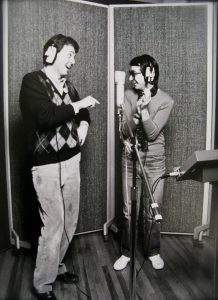
Is it flattering that you played on 5 Paul McCartney albums (“Tug of War”, “Pipes of Peace”, “Give My Regards to Broad Street”, “Flowers in the Dirt”, “Run Devil Run”) ?
Yeah, I’m very flattered that he kept calling me back. I saw him a few years ago when he came to Boston and he was super, super friendly. Even though on some of those records I’m only on one track -I think on “Flowers in the Dirt” (1989) I’m on just one track- the mere fact that he asked me back is incredibly flattering. He’s one of the nicest and easiest people to work with. Like a lot of the people I’ve been fortunate enough to work with, he almost never tells you what to play.
Did you enjoy playing in “We Got Married” song from Paul McCartney’s “Flowers in the Dirt” (1989) with David Gilmour?
Oh, yeah, that was great fun. That was a good one. I saw David two years ago. I was doing a UK tour with Richard Thompson and we played the Albert Hall. David showed up, and I realized I hadn’t seen him since those sessions. It was really nice to see him again. Yeah, that was great, playing with David. I mean, he’s David Gilmour (laughs).
There is a nice photo that came up with David and you in the background.
In Paul’s recording studio in Sussex, yeah. I’ve seen that photo. Nobody was doing selfies every five minutes back then -we just got on with it.
You had a scheduled session with George Harrison the day of John Lennon’s assassination. Were you surprised that he didn’t cancel it?
Yeah, I was. Ray Cooper (ed: Elton John – percussion), who produced it, is a friend, and he’d spoken to George earlier that day. George felt it was better to stay busy and do something rather than sit around thinking about it. I think that’s why he decided to go ahead with it.
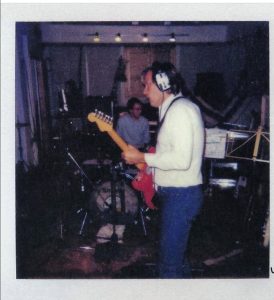
Was the atmosphere a bit heavy?
No, it wasn’t. I wouldn’t say it was heavy. I mean, everyone was aware of what had happened, but when it came time to make music, there was no negativity in the air as far as making music was concerned. We did sit around afterward and talk about it, but no, there was no negativity when it came to making music.
You worked with George Martin (The Beatles producer) in the studio on several occasions. What was that experience like?
George was one of the greatest producers I was fortunate to work with, along with people like John Wood, Glyn Johns (ed: Eric Clapton, Led Zeppelin), and Gus Dudgeon (ed: Elton John). George really was the ultimate gentleman, both in terms of his personality and the way he produced. He would always find a way to be incredibly encouraging, and if he heard something he didn’t like, he had a very gentle way of guiding you away from it and towards something he felt was more musically appropriate. Everything I did with George was enjoyable -even the couple of tracks I played on the album based on Dylan Thomas’ “Under Milk Wood” (1988). That was a very interesting project with a rather disparate group of artists. But the work I did with Paul and Gary Brooker’s album “No More Fear of Flying” (1979), were particularly memorable. I think my first interaction with George was for an artist called Cilla Black. I was very young, very full of piss and vinegar, and very full of myself. At that age, in your 20s, you think you know everything. I remember I had a very small bass drum with two heads on it, and Geoff Emerick (ed: The Beatles engineer) asked me to remove the front head. Geoff Emerick, for Christ’s sake -the guy who recorded “Sgt. Pepper”! (laughs) And I remember saying: “No, I’m not gonna do that. No, I’m not gonna take the front head off”. I mean, Geoff Emerick and George Martin -how big a pair of balls would you have to have to say that? But it wasn’t balls; it was youthful ignorance and stroppiness, which I had far too much of at the time. I look back on that encounter with a certain amount of horror, and I’m also amazed that George called me back afterward (laughs) to work with him again.
How much has your approach to drums changed over the years?
A lot. I think the best way for me to summarize it would be to say that my technique isn’t what it used to be, but my editing has gotten a lot better.
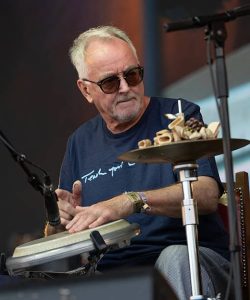 Who are your influences as a drummer?
The usual ones that everybody talks about: Ringo, Charlie Watts, Levon, Jim Keltner (ed: John Lennon, George Harrison, Bob Dylan – drums). Kenny Clare, who was a wonderful English jazz big band player, played with hundreds of people, including the Francy Boland Big Band. He was big in the session scene when I was growing up, and he was a huge influence on me, both in terms of his sound and his approach. But one of my greatest musical heroes is Paul Motian. I absolutely love Paul Motian. Then, of course, I know I’m going sideways here, but I’m flattered that I know Joe LaBarbera, Bill Evans’ (ed: Miles Davis – piano) last drummer. He is a wonderful, wonderful drummer. Shelly Manne was a big influence on me, but Paul Motian really changed my perception of how a drum kit could sound and how it could be played.
Do you consider yourself a jazz drummer?
On my passport it says “musician”, and that’s what I think of myself as. I started playing piano when I was six years old and when I approach a piece of music, I always like to know where the song is going harmonically. When I make notes, I’m usually writing the chords on the chart. Usually -not always- the last thing I think about is any kind of drumbeat. Because you start playing it and the other musicians might say: “That drumbeat I thought was going to work doesn’t fit anymore. I’m hearing everything now”. I’m not really interested in the drumbeat itself. I’m very fond of that quote from Tony Williams, when somebody asked him: “Show me the beat or the rhythm that you played on… blah blah blah”, and Tony said: “‘Show me a beat?’ I can teach my postman to play a beat. I’m really talking about making music here”. I’m always interested in where the music and the songs I’m playing are going harmonically. That’s my golden rule, if you like and then I start thinking about the drums.
Tony Williams came from Boston and joined Miles Davis when he was 17 years old. Are there those kinds of opportunities nowadays?
I think the opportunities are there, but instead of a player’s reputation being spread by word of mouth, it now seems to spread by how many likes a YouTube video has. I’m constantly inundated with clips of people sending me: “Oh, listen to this guy”, “check this person out”, and sometimes it’s fantastic. But I’m always interested in seeing that player sitting with a blues band, for example, and somebody says: “Okay, flat tire shuffle, we’re coming in on the five” and seeing how they react. All the best young players have the technical command and I can tell pretty much straight away whether they’re really listening to what’s going on around them rather than just trying to impress. I know that’s an easy target and I’m trying not to be too much of an old dick, but I do see a lot of excellent young players coming up. And I think, personally, I can get a sense of when those players are playing appropriately and that’s a very all-encompassing term. There are some players who have a lot of technique, but sometimes I become too conscious of the “look-at-me” factor. Let’s leave it at that.
 Did you like Ginger Baker (Cream, Blind Faith) as a drummer?
It took me a while to get Ginger. Yes, he had a very unique thing, and his big influence was one of England’s greatest drummers, a guy called Phil Seamen, who was a fantastic jazz drummer who also did recordings and other things. It was Phil who really turned Ginger on to an alternative way of thinking. Yeah, he was a unique drummer. There were a lot of really great players who came out of that era. I knew Ginger a little bit. I knew Mitch (ed: Mitchell – Jimi Hendrix Experience). Mitch used to come into the shop where I worked in London when I was a teenager, before I turned professional. Mitch was a few years older than me, and he was a real Elvin (ed: Jones – drums) freak. He would just come into the shop and say: “You know the Elvin record?” and then he’d play the lick that he had just heard Elvin doing. Then one day he came in and said: “I think I’m going to go with this black guitarist. I think this is going to go somewhere”. And the next thing I knew, he was on “Top of the Pops”, the English TV show, doing “Hey Joe”, and it went from there.
By the way, Ginger Baker said that John Bonham “couldn’t swing a shack of shit”. Do you agree with this?
(Laughs) No, I don’t. Of course, it’s Ginger. Ginger was the most irascible kind of person. He was a great drummer, but… I presume you’ve seen the documentary “Beware of Mr. Baker” (2012). That really tells you what you need to know about him. But I don’t agree with him, no. I think that’s one of the things that separates Bonham from a lot of heavy rock drummers, because John’s sound really came out of the big band era. He tuned his drums like the big band drummers did, but he just took it to another level. John had a great swing to his playing. He really had a great swing to his playing.
Did you get on well with Jimmy Page when you collaborated on the “Death Wish II” (1982) soundtrack?
Yeah, that was very enjoyable. I learned a lot from Jimmy. He was a very easy-going person. It was the same thing again, Thodoris -he was never dictatorial. He would simply offer ideas and then let me get on with it. He came up with some great ideas, but he never tried to impose them on me.

A lot. With the kind of work I’ve been fortunate enough to do over the years, people call you because they have a sense of your approach and your musical sensibility. Obviously, I would take direction. I’m not one of those people who would ever say: “I’m not playing that”. If somebody asked me to play something that I felt was musically inappropriate, I’d probably say: “Would you mind if I gave you an alternative that I think is in the direction you’re after?” Hopefully, you reach a compromise. Generally speaking, though, there wasn’t much direction. When I was doing the XTC record (ed: “Nonsuch” -1992), Andy (ed: Partridge – vocals, guitar) definitely had some ideas about drum patterns, which I was happy to go along with. Sometimes I’d put my own spin on them, and sometimes I’d try to do what he wanted. The track “Omnibus” was difficult. Once I finally figured out what he wanted, hopefully I gave him a version that he liked. But over the years, there really wasn’t much direction. Again, it comes back to the fact that, as a musician, whatever your instrument, you develop a reputation -for better or worse. On the few productions I’ve done, if I’ve got the right player, I can simply say: “It’s a bit more like this”, or “it’s a bit more like that”, and leave it to them. If you’re constantly saying: “Not like that”, “no, it needs to be like this”, “don’t play that figure there”, or “I’m not keen on the sound -can you change it?”, then you’ve probably got the wrong player.
That’s not to say I’m not open to people’s suggestions -I was and still am. Someone might say: “I think you’re barking up the wrong tree with that. It’s more like…” and I’d respond: “Oh, do you mean something like this?” Then they’d say: “Yes, that’s exactly it”. It’s very different if you’re working in the film world, or on television series, or in jazz fusion, where every 32nd note is written out. But when you’re playing with songwriters, there’s an inherent trust among all the musicians, not just the drummer. As I said, if a musician keeps playing things that are musically inappropriate, that musician might be really great in another genre. That’s why musicians develop reputations and, to some extent, get pigeonholed. I don’t necessarily think that’s a bad thing. There are only a very small handful of musicians who break that rule. The most obvious example is, of course, Steve Gadd (ed: Eric Clapton, James Taylor, Steely Dan). Steve can play the most sensitive singer-songwriter material and then play unbelievable heavy-duty jazz fusion. There aren’t many musicians who can do that, which is why he’s held in such high regard. When I hear other players step outside their comfort zone, it can sometimes sound unconvincing, depending on the player and the situation. With Steve, though, he’s a very rare beast -he sounds convincing in every genre. I have a real love for the Great American Songbook and I enjoy playing jazz in that idiom. I don’t do it very often, but I’ve made a couple of records in that style. Generally speaking, though, my thing has always been singers and songwriters.
How different are the dynamics within the rhythm section when you play with Dave Pegg compared to Paul McCartney?
They’re both unbelievably great bass players. For me, locking in with a bass player is pretty straightforward. It comes down to the time feel and the note choices. Every musician has a microsecond tendency to lean one way or the other. Mine is -for better or worse, some people I know don’t like it, but I’m too old to change it now (laughs) – to play on the back of the beat. So if I’m playing with a bass player who is either right on the beat or slightly behind it, we’re good. But if I’m playing with someone who sits right on the front of the beat, it doesn’t feel comfortable. So, time feel is the most important thing. After that come the notes they choose to play, and then the sound. I’ve been very fortunate to play with so many great bass players: Dave Pegg, Paul, Pino (ed: Palladino – The Who, John Mayer), whom I’ve made a couple of records with, and Dave Bronze (ed: Eric Clapton, Tom Jones), who’s a phenomenal bass player. Dave’s a friend as well as a wonderful, wonderful musician. I’ve also been lucky enough to play with some really great bass players in Boston. Again, just to reiterate, it’s all about feel. You can just tell. Another thing that contributes to the connection between me and Dave Pegg is simply longevity. When you’ve been playing with somebody for that long, you really do -in a positive way- get used to each other’s playing.
Have you ever thought about writing your autobiography? It would be a very interesting read.
No, no. No plans (laughs). There are plenty of books out there by people far more interesting than me. No.

Are you surprised when you learn that Fairport Convention influenced musicians such as Nile Rodgers?
Yes, I was surprised. But as you probably know, when Chic played the Cropredy Festival a few years ago, he made that claim and said that he had listened to the band. It was quite a surprise, but I wouldn’t necessarily be surprised, because again, the musicians I look up to all have a broad take on things. By the way, talking about musicians that I look up to, one of them is somebody you recently interviewed -although I haven’t had a chance to read it yet- and that’s Peter Erskine (ed: Weather Report, Jaco Pastorius – drums), who I’m a huge fan of. Peter is one of those players. I would put Peter in the same category as Gadd.
But he is younger than you. He was born in ‘54.
Yeah, I know. He’s a youngster compared to me (laughs). He’s another one of those guys who can play unbelievably great jazz but then also be really great with a singer-songwriter. He did an album a few years ago (ed: “Songs from the Movie” – 2014) with a singer I used to work with back in the ’90s, Mary Chapin Carpenter, and I heard what he did on that record -it was beautiful. He’s another consummate musician.
He told me that when he listened to a track that Jeff Porcaro (Toto, Steely Dan) played, he cried partly because his playing was so perfect. Have you ever experienced this?
Almost on a daily basis, yes. (laughs) There are a handful of guys out there who are just on another level -people like me can only aspire to get close to that. I know exactly what he means. When I hear a great performance, and again, at the risk of stating the obvious, especially for me these days, it has very little to do with technique. It’s more about how that person has fitted their playing to the music they’re performing. The ECM albums that Peter did with the English piano player John Taylor contain some of the greatest contemporary jazz playing from him. I love that trio: John Taylor, Palle Danielsson (double bass) and Peter.
 How important was Joe Boyd‘s contribution to the success of Fairport Convention?
Joe, I think, was very important. Joe is a different kind of producer from some of the producers I’ve worked with. In the early days, I became very used to what I call “hands-on producers” -producers who would say: “No. Put an A-flat underneath that beat or that chord,” blah, blah, blah. Joe is the antithesis of that. Most of the time, as the cliché goes, his feet were up on the desk and he was reading the paper, but he had -and continues to have- an incredibly good instinct for knowing when something is aesthetically right or wrong, which is why the Fairport, Richard & Linda (ed: Thompson), Nick Drake, and world music records are as good as they are. He has a very good taste, and he’s incredibly knowledgeable. At the time, I was a little unsure about it, but over the years I’ve learned that having those qualities is more important than being boisterous in the studio, bossing people around, or anything like that. I won’t mention any names, but there have been some producers I’ve worked with who weren’t dictatorial, but were very much “do this”, “do that” and so on. The producers I’ve been fortunate enough to work with -the “big names”, like Glyn Johns, John Wood and George Martin -aren’t like that. They choose the musicians, let them get on with it and then steer them if they feel they’re moving in the wrong direction. And they do it so subtly that you don’t even realize it’s happening to you. That’s an incredible skill.
George Harrison’s music, Santana’s music, Jimi Hendrix’s music has also a strong spiritual aspect. Is today’s music spiritual?
I don’t hear too much of it. What I do hear, in some quarters -especially in some of the worst country music -is a lot of flag-waving Christian stuff. When it comes to religion, my attitude is: “Whatever makes you happy. Don’t harm anyone and get on with your own life”. No, maybe I’m just not listening to the right things. I’m not up to date with all contemporary music, but no, I’m not really conscious of that. I do hear a lot of great contemporary songwriters and there’s a lot of good music being made. I’m not one of those people who say: “Oh, it was so great in the ’60s and ’70s and everything modern is crap”. I think there’s some wonderful stuff being made. But I would agree with you that maybe there is a lack of deep spirituality in contemporary music.
Keith Emerson told me: “In the ‘60s and 70’s the music was more important to people. It was a huge event when The Beatles released a new album. You should listen to George Harrison’s guitar. You should listen to Paul McCartney’s bass. You should listen to John Lennon’s lyrics. Nowadays nobody gives a shit about who the guitar soloist is on a Lady Gaga album”.
I’m inclined to agree, but I always have to be careful not to sound like an old fart when I say that. One of the best quotes I’ve heard, generally speaking, about the state of contemporary music was from Vince Gill, who is a phenomenal player. Somebody asked him about downloads, and he said: “The devaluation of music and what it’s now deemed to be worth is laughable to me. My single costs 99 cents. That’s what a single cost in 1960. On my phone, I can get an app for 99 cents that makes fart noises – the same price as the thing I create and speak to the world with. Some would say the fart app is more important. It’s an awkward time. Creative brains are being sorely mistreated”. I thought: “Yeah, that’s where we are”. The era of turning over an album sleeve to see where it was recorded, who the musicians are, who the producer was, who wrote the songs -that seems, relatively speaking, to be a thing of the past. People who are really interested in music, regardless of age -whether they’re young, middle-aged, or old- will find out, because obviously, with the internet, you can look this stuff up. But we’re in a different era, for better or worse. I think the last time I sat down and listened to an entire album from beginning to end was around Christmas. It was Bill Frisell’s “Orchestras” (2024). It was just so great.

No. I think he came into the music shop where I used to work once, and he was in and out, but no, I never met him. He was an incredible stylist. Again, it took me a while to appreciate Keith because his approach was almost the polar opposite of mine. But as I grew older and my ears got wider, I learned to appreciate what he did. And what he did in that band was phenomenal, which is why they had such a hard time replacing him. Having said that, I thought Kenney Jones (Small Faces, Faces) did a good job and Simon Phillips did a really great job. Zak (ed: Starkey – Ringo Starr’s son) also did a great job, but Keith really was a one-off.
Why did you decide to move to Massachusetts in 1998?
Because I couldn’t get arrested in England. I was hardly working at all, whereas I was working a lot more in the States. I was playing with Mary Chapin Carpenter and developing friendships in Boston. I’d always wanted to go there and one thing led to another, and that was it. It was a combination of a cultural shift and work. Fortunately, my wife was happy to go along with it. God bless her.
Could you describe to us your first meeting with Ringo Starr?
I was lost for words. Fortunately, the first time I met him was at AIR Studios in London. I was doing a track with Paul, and Ringo came into the studio, so Paul introduced me to him. But it was all over in five or ten minutes, and that was about the closest I got to him. But yeah, what can you say when you meet your heroes? It was difficult enough for me the first time I met Paul -I nearly made a complete fool of myself. But Paul is very good at making people feel at ease, and he did make me feel comfortable, so eventually I calmed down. You might say: “OK, hello, yes, I’m pleased to meet you”, but inside you’re thinking: “What the hell?! It’s Paul McCartney”. I don’t think many people ever get over that. Maybe Wings and the band he’s had for the last 20 years. Those guys are unbelievable. I’m sure they are used to being around him. It’s a Beatle, for Christ’s sake!

I think there is an element of modesty, whether it’s false or not. Charlie definitely thought of himself as the ultimate accompanist in that rock band, with this incredible love for jazz. Bill -I’m surprised that he calls himself a jazz drummer. Bill is one of the most educated and knowledgeable drummers I’ve ever come across. I’m very fortunate to call Bill a friend. We don’t talk very much, but I can certainly call him a friend. I don’t know what it is about calling themselves that.
Some English drummers that I’ve talked to, like Kenney Jones, Jerry Shirley (Humble Pie, Syd Barrett, Fastway) and Bev Bevan (The Move, ELO) have mentioned Brian Bennett of The Shadows as an influence. Did you like him?
Yes, I did meet him a couple of times. He is a little distant, but he seems a very personable guy, and he is a great drummer. That band is like the English version of the American band The Ventures. They were an instrumental band and they backed a very famous English pop star, Cliff Richard. There was a drummer before Brian. I remember, as a youngster, being very influenced by him. His name was Tony Meehan. Then he left, Brian took his place, and he really put his stamp on that band and did it very well indeed.
A huge “THANK YOU” to Mr. Dave Mattacks for his time.
Dave Mattacks Official website: https://www.davemattacks.com/
Dave Mattacks Official Facebook page: https://www.facebook.com/dave.mattacks
Fairport Convention Official website: https://www.fairportconvention.com/